


Hello! I'm Parag
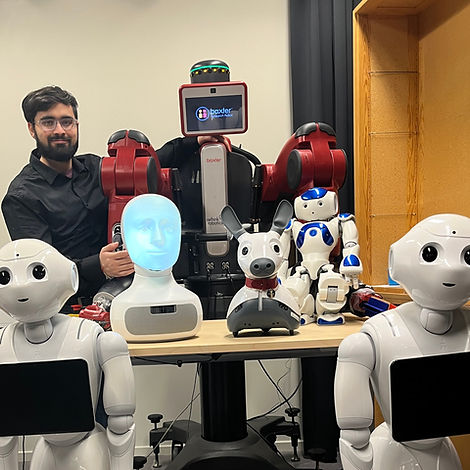
I like to make devices and algorithms that can make human work easier and am highly interested in developing and designing various autonomous tools and robots. I love to learn new things and concepts. I finished my PhD at KTH Royal Institute of Technology in Stockholm, Sweden, in March 2025. Currently, I am working as a Postdoctroal Researcher at KTH in Human-Robot Interaction. You can read about my current work here.
I am a self-motivated and collaborative roboticist specializing in Human-Robot Interaction (HRI), machine learning-based adaptive robot behavior, and robot system design and integration. My interdisciplinary research blends insights from human behavior, cognitive science, and robotics to develop intuitive and explainable robotic systems, with a focus on handovers, failure recovery, and physical interaction. I am passionate about creating devices and algorithms that simplify human work and am particularly interested in designing autonomous tools and robots.
My work applies data-driven methods, emphasizes sim-to-real transfer, and promotes adaptive, user-centered interaction strategies. With the goal of taking robotics from labs to real-world environments, I prioritize collaborative, impactful research that addresses real-world challenges and applications.
NEWS
-
Dec 2025: Starting new role as a Research Affiliate at Karolinska (Biomedical) Institue, Stockholm.
(Ongoing Medical Robotics project) -
Dec 2025: Supervised Master's student successfully defended his thesis on "Developing a Robotic Solution to Genetically Manipulate Mice in Utero".(collaborative porject at Karolinska Institue, SE)
-
Dec 2025: Supervised Master's student successfully defended his thesis on "Inspiring Human-Robot Handovers from Human-Human handovers: Effects of object-weights in handovers."
-
Nov 2025: Selected for Future Digileaders Workshop 2025 at Digitalize in Stockholm Conference by Digital Futures-KTH.
-
Oct 2025: Attended and Presented a paper at IEEE IROS 2025. Co-organized a workshop as well.
-
Sept-Oct 2025: Lead organizer for the 2nd version of the Real World Physical and Social HRI Workshop at IEEE Humanoids 2025, Seoul, South Korea.
-
Sept 2025: Supervised Master's student successfully defended her thesis on "Disassembling the Problem A Frame Creation-Based Strategy for Human-Centered Automation in ELV Recycling". (hosted at Volkswagen AG, Germany)
-
Aug 2025: Awarded! The Best Poster Award at the KTH-EECS Research and Impact Day 2025.
-
Aug 2025: Attended and Presented a paper at IEEE RO-MAN 2025 in Netherlands.
-
Jul 2025: Awarded the 2025 HRI RAS Registration Reimbursement award for the HRI Conference, 2025, Melbourne, Australia.
-
Jul 2025: Accepted! 2nd version of Real World Physical and Social HRI Workshop accepted at IEEE Humanoids 2025.
-
Jul 2025: Supervised Master's student successfully defended his thesis on "Adaptive Robotic Failure Explanations for Human-Robot Collaboration."
-
Jun 2025: Accepted! Paper accepted for presentation at the IEEE IROS 2025.
-
May 2025: Accepted! Paper accepted for presentation at the IEEE RO-MAN conference 2025.
-
May 2025: Attended and Presented a RA-L journal paper at the IEEE ICRA conference 2025.
-
May 2025: Starting a new collaborative project in medical robotics with the Karolinska Institute, Stockholm.
-
Apr 2025: Awarded! IEEE RAS Travel Grant for IEEE ICRA 2025 attendance.
-
Apr 2025: Started as a Postdoctoral Researcher at RPL-KTH.
-
Mar 2025: Defended! my PhD Thesis on 31st March 2025.
-
Mar 2025: Our REFLEX dataset paper received Honorable mention for the Best Short Paper Award at the HRI conference.
-
Mar 2025: Attended the ACM/IEEE HRI conference and presented the REFLEX dataset paper. Participated in the HRI Pioneers workshop.
-
Jan 2025: Submitted the final draft of my PhD thesis for internal review at RPL-KTH.
-
Jan 2025: Selected for prestigious HRI pioneers workshop to be held at the HRI 2025 conference.
------------------------------------------------------------------------------------------------------------------- - Dec 2024: Accepted! Paper accepted at HRI 2025! Nominated for Best Short Contribution Award.
-
Nov 2024: Attended IEEE Humanoids 2024 in France. Lead organizer for the Real World Physical and Social HRI Workshop at IEEE Humanoids 2024, Nancy, France.
-
Nov 2024: 2 Master's Projects successfully completed under my supervision at RPL-KTH.
-
Oct 2024: Received Travel Scholarship from the Karl Engvers Foundation-KTH, Stockholm
-
Aug 2024: Paper published in IEEE RA-L journal.
-
Aug 2024: Accepted! Workshop on Real World Physical and Social HRI accepted for IEEE Humanoids 2024.
-
Sep 2024: Selected to Represent KTH at the Unite! Research School in Grenoble, France, 2024.
-
Jun 2024: A Master's summer internship completer under my supervision at Digital Futures-KTH.
-------------------------------------------------------------------------------------------------------------------
-
Nov 2023: Supervised Master's student successfully defended his thesis on Automated Control of Human-Robot Handovers using Data-driven STL Modeling of Human-Human Handovers.
-
Dec 2023: Awarded! the Best Poster Paper award at the International Conference on Human-Agent Interaction (HAI) 2023.
-
Sep 2023: Attended and Presented 2 papers at IEEE RO-MAN 2023 in South Korea.
-
Jun 2023: Accepted! 3 papers accepted for presentation at IEEE RO-MAN 2023.
-
Feb 2023: Attended the HRI conference in Stockholm. Presented a workshop paper.
-------------------------------------------------------------------------------------------------------------------
-
Nov 2022: Attended the IEEE Humanoids conference in Japan. Presented a paper and a workshop paper.
-
Aug 2022: First PhD paper accepted for publication in IEEE Humanoids 2022.
-------------------------------------------------------------------------------------------------------------------
-
Jun 2021: Started my PhD! Doctoral Candidate at the Division of Robotics, Perception and Learning at KTH Royal Institute of Technology, Stockholm, Sweden.
-
2021: Accepted! A journal paper accepted for publication in the Journal for Mechanisms and Robots.
------------------------------------------------------------------------------------------------------------------- -
2020: Attended ICRA 2020 virtually. Oral paper presentation for our paper on bird-neck-inspired tensegrity-based manipulator.
-
2020: Selected to take our tensegrity-based manipulator for robot presentation at ICRA 2020 in paris.
-
2020: Accepted! Paper accepted for IEEE ICRA 2020.
-------------------------------------------------------------------------------------------------------------------
-
Dec 2019: Accepted! Paper accepted at 24ème Congrès Français de Mécanique, France.
-
Nov 2019: Started as Research Engineer in Project Avineck at LS2N, Nantes.
-
Aug 2019: Master's thesis Defended!
-
Feb 2019: Started as Masters Thesis Intern at the LS2N lab at the CNRS (National Center for Scientific Research) in Nantes, France.
-------------------------------------------------------------------------------------------------------------------
-
Aug 2018: Started 2nd year of Masters at Ecole Centrale de Nantes in France.
-
Jun 2018: Awarded! Erasmus Mobility for Masters studies at Ecole Centrale de Nantes in France
-------------------------------------------------------------------------------------------------------------------
-
Aug 2017: Started my Master's studies at University of Genoa under Erasmus Mundus European Masters on Advanced Robotics (EMARO+)
-
Jun 2017: Defended! my Bachelor's Thesis, Bachelor of Technology in Mechanical Engineering, completed at Visvesvaraya National Institute of Technology (VNIT Nagpur).
-
Jun 2017: Filed a patent application for the Flying Snake project.
-
May 2017: Awarded! the VNIT Excellence Award 2017 for exhibiting Successful and outstanding work in the field of Science and Technology (Innovative Projects).
-
Mar 2017: Represented VNIT at the Meeting of National Innovation Club Members, 2017 held at The President's House, New Delhi, India.
------------------------------------------------------------------------------------------------------------------- -
2016: Attended IEEE ROBIO 2016 in China. Presented paper on Prosthetic Hand.
-
2016: Accepted! Paper selected for publication in IEEE ROBIO 2016.

Parag Khanna
Postdoctoral Researcher at KTH Royal Inst. of Technology.
Secondary Affiliation: Karolinska Institute, Stockholm
Keywords: Robotics, Human-Robot Interaction.
Email:
Address:
Sweden, Stockholm
Date of Birth:
June 26th, 1996
Current CV:
{Link}
EXPERIENCE
April 2025 - Currently
PostDoctoral Candidate
Masters Thesis Supervisor
KTH-Teaching Assistant
Robotics, Perception and Learning (RPL), KTH Royal Institute of Technology, Sweden
Research on HRI, Human-Robot Handovers, Explanation for robotic failures in human-robot collaboration.
Medical Robotics
Masters Course: Introduction to Robotics (DD2410)
May 2021- March 2024
Doctoral Student
Masters Thesis Supervisor
KTH-Teaching Assistant
Robotics, Perception and Learning (RPL), KTH Royal Institute of Technology, Sweden
Research on Human-Robot Interaction, Human-Robot Handovers, Explanation for robotic failures in human-robot collaboration.
Masters Course: Introduction to Robotics (DD2410)
Masters Course: Machine Learning (DD2421),
Masters Course: Artificial Intelligence (DD2380)
Nov 2019-May 2021
Research Engineer
Centre National de la Recherche Scientifique (CNRS), at LS2N lab, Nantes France
Project on developing a bird-neck inspired tensegrity based manipulator {paper}
May 2016-July 2016
Internship
PLYMOUTH UNIVERSITY, UK
Project on applying Machine Learning Algorithms(NSM: Reinforcement Learning) on real world tasks being performed by a robot, under Prof. Torbjorn Dahl.
Nov 2015-Dec 2015
Internship
ROBOTIC LABS ,MECHANICAL ENGINEERING DEPARTMENT VNIT NAGPUR, INDIA
Project on Autonomous Quadcopter under Prof. S.Chiddarwar.
May 2015-July 2015
Internship
CENTRE OF EXCELLENCE, VNIT NAGPUR, INDIA
Project on Design, control and fabrication of low cost prosthetic hand under Prof. K.M. Bhurchandi, Electronics Department, VNIT.
THESIS AND PROJECT SUPERVISION
Master's Degree Thesis
Student Name: Yongze Qin
Title: "Automated Robotic Injections in Mice with tissue tracking"
Mar 2025 - Aug 2025
Volkswagen, Germany, and KTH, Sweden
Master's Degree Thesis
Student Name: Bashar Abo
Title: "Adaptive Robotic Failure Communication: LLM–VLM-Based Failure Explanation Generation and Adaptation"
Jan 2026 - Aug 2026
KTH, Sweden
Master's Degree Thesis
Student Name: Linda Maria Seseke.
Title: "A Decision-Making Framework for Modern and Future Vehicle Disassembly"
LINK
May 2025 - Sep. 2025
Volkswagen, Germany, and KTH, Sweden
Master's Degree Thesis
Sydunet Name: Alice Wijitchakhorn.
Title: "Adaptive Robotic Grip Release for Human-Robot Handovers: Understanding and Adapting to Human Taking Behaviors Using Reinforcement Learning
Jan 2026 - Aug 2026
KTH, Sweden
Master's Degree Thesis
Student Name: Chenhao Yue.
Title: "Developing a Robotic Solution to Genetically Manipulate Mice in Utero"
May 2025 - Dec. 2025
Karolinska Institute, and KTH, Sweden
Master's Degree Thesis
Student Name: Haoyun Zhou,
Title: "Adaptive Robotic Failure Explanations for Human-Robot Collaboration"
LINK
Jan 2025 - Jun 2025
KTH, Sweden
Master's Research Project
Student Name: Karen Jane D'souza,
Title: "Weight Matters: An Investigation into Human Handover Behavior and Its Implications for Human-Robot Object Handovers."
Related Paper: LINK, Dataset: YCB-Handovers
Feb 2024 - Nov 2024
KTH, Sweden
Master's Degree Thesis
Student Name: Zixuan He
Title: "Visual-Language-Model Enabled Robotic Failure Prediction and Proactive Explanations for Failures"
Jan 2026 - Aug 2026
Uppsala Universtity and KTH, Sweden
Master's Degree Thesis
Student Name: Chunyu Wang.
Title: "Inspiring Human-Robot Handovers from Human-Human handovers: Effects of object-weights in handovers"
Related Paper: LINK
Feb. 2025 - Dec. 2025
KTH, Sweden
Master's Summer Internship
Student Name: Andreas Naoum
Title: "Failure Communication in Human-Robot Collaboration with Multimodal AI and Large Language Models"
Related Paper: LINK
May 2024 - July 2024
KTH, Sweden
RESEARCH
JOURNAL PAPERS
"Early Detection of Human Handover Intentions in Human-Robot Collaboration: Comparing EEG, Gaze, and Hand Motion", Journal Robotics and Autonomous Systems (RAS) | 2025
This paper investigates how reliably and how early a robot can distinguish between handover-intended and non-handover actions using three modalities: electroencephalography (EEG), eye gaze, and hand motion signals. The study develops and evaluates intention detectors for each modality in a controlled human–robot handover task, showing that all three can reveal upcoming handover intentions, with gaze offering the earliest and most accurate predictions compared to EEG and motion-based cues.
"Impact of Object Weight in Handovers: Inspiring Robotic Grip Release and Motion from Human Handovers", in submission, under review at Journal Robotics and Autonomous Systems (RAS) | 2025
This work analyzes how varying object weight shapes human strategies for timing, grip release, and arm motion during handovers. Using motion-capture (MoCap) recordings of human–human handovers with objects of different masses (and publishing them as datasets), the study extracts kinematic features and grip-release patterns to show systematic adaptations in when and how people release objects, and how they modulate trajectory and speed. These empirically derived patterns are then used to design and implement weight-dependent robotic grip-release and motion policies, enabling robots to adjust their handover behaviour more naturally and safely as object weight changes.
"Hand it to me Formally! Data-driven Control for human-robot handovers with Signal Temporal Logic,"
Journal IEEE Robotics and Automation Letters (IEEE R-AL) | 2024
This work introduces a control framework that learns human handover behaviour from motion-capture data and encodes it in Signal Temporal Logic (STL) specifications. These STL specifications capture timing and spatial properties of successful human-human handovers from Handovers@RPL dataset and are then used to automatically synthesize robot controllers that generate efficient, human‑like, and transparent handover motions in human–robot interaction.
"Identification and control of a 3-X cable-driven manipulator inspired from the bird’s neck,"
Journal of Mechanisms and Robotics (JMR), | 2021/2022
This work presents advanced modeling, identification, and control strategies for a multi-module tensegrity manipulator that mimics bird neck flexibility using cable-driven 3-X tensegrity joints. The work develops precise dynamic models accounting for cable tensions and joint compliances, validates them through experimental identification, and implements robust control laws that achieve accurate trajectory tracking despite the system's underactuated and highly compliant nature. This research demonstrates the feasibility of bio-inspired tensegrity robotics for applications requiring high dexterity, adaptability, and lightweight construction in constrained environments.
"Adapting robot's explanation for failures based on observed human behaviour in human-robot collaboration",
IEEE International Conference on Intelligent Robots and Systems (IROS), 2025
This work develops a data-driven predictor that interprets human behavioral signals (facial emotions, gaze, gestures) from a user study and corresponding REFLEX dataset with 55 participants to anticipate confusion during robot failure explanations. The approach analyzes human reactions across failure, explanation, and resolution phases to determine if reducing explanation detail would induce confusion, then adapts the robot's explanation level accordingly for more efficient collaboration. Promising preliminary results show this mechanism can effectively minimize confusion while optimizing explanation verbosity based on real-time human feedback.
"REFLEX Dataset: A Multimodal Dataset of Human Reactions to Robot Failures and Explanations",
ACM/IEEE International Conference on Human-Robot Interaction (HRI) | 2025
🏆Honorable Mention Best Paper (Short Contribution), Best Paper Award Nominee
This work presents a comprehensive multimodal dataset, called REFLEX, capturing human behavioral responses (facial emotions, gaze patterns, gestures, timing) to robot task failures and subsequent explanations in collaborative scenarios. Recorded across failure occurrence, explanation delivery, and recovery phases, REFLEX enables analysis of how humans process robotic errors and interpret adaptive explanations, supporting development of context-aware failure communication systems. Awarded Honorable Mention Best Paper at ACM/IEEE HRI 2025, the dataset provides critical ground truth for training models that predict user confusion and optimize robot explanation strategies in real-time HRI
"YCB-Handovers Dataset: Analyzing Object Weight Impact on Human Handovers to Adapt Robotic Handover Motion",
IEEE International Conference on Robot and Human Interactive Communication (RO-MAN) | 2025
This work introduces a dataset of 2,771 motion-captured human–human handovers using YCB objects across varying weights, addressing a gap in weight-sensitive handover research for intuitive robotic motion planning. The dataset reveals how object mass systematically influences human reaching trajectories, timing, and readiness cues, enabling data-driven models for adaptive robotic behaviors that mimic natural handover patterns. Covering a wide weight range including objects requiring careful handovers, it supports robust analysis of weight effects on handover dynamics and human-inspired robot control strategies.
"Adapting Robotic Explanations for Robotic Failures in Human Robot Collaboration",
ACM/IEEE International Conference on Human-Robot Interaction (HRI), 2025. (HRI-Pioneers Abstract) | 2025
This work explores strategies for robots to dynamically adjust failure explanations based on human responses during collaborative tasks. The work analyzes user reactions to robotic failures and develops adaptive mechanisms that tailor explanation verbosity and content to individual user needs, improving task resolution efficiency and trust. Presented at the HRI 2025 Pioneers workshop, it demonstrates how real-time behavioral observation enables more intuitive and effective human-robot communication during failure scenarios.
"How do Humans take an Object from a Robot: Behavior changes observed in a User Study",
International Conference on Human-Agent Interaction (HAI) | 2023
🏆Best Poster Award
This examines how humans adapt their taking behaviors when receiving objects from robots in repeated interaction for robot-to-human handovers. Awarded Best Poster at HAI 2023, these findings provide essential insights for designing reciprocal robot handover behaviors that could better accommodate natural human expectations and movements.
"A Multimodal Data Set of Human Handovers with Design Implications for Human-Robot Handovers",
IEEE International Conference on Robot and Human Interactive Communication (RO-MAN) | 2023
This paper presents a comprehensive dataset capturing synchronized motion capture (MoCap) and force/torque from human–human handover interactions, providing rich ground truth for analyzing natural handover kinematics and dynamics. The dataset reveals key patterns in grip release timing, interaction forces, and interpersonal coordination in human handovers that directly inform robot handover design, enabling more fluid and intuitive human–robot physical collaboration. Through detailed analysis of these multimodal signals, the work identifies actionable design principles for robots to better match human expectations in collaborative manipulation tasks.
"Detecting the Intention of Object Handover in Human-Robot Collaborations: An EEG Study",
IEEE International Conference on Robot and Human Interactive Communication (RO-MAN) | 2023
This work investigates neural correlates of handover intention using electroencephalography (EEG) during human-robot collaborative tasks. The study analyzes brain signals to distinguish between handover-intended and non-handover actions, demonstrating that EEG patterns can provide early cues for robots to anticipate human intent before overt motion cues become available. These findings enable proactive robot behaviors that improve timing and safety in physical human-robot collaboration by leveraging brain-computer interface technology for intention prediction
"Effects of Explanation Strategies to Resolve Failures in Human-Robot Collaboration",
IEEE International Conference on Robot and Human Interactive Communication (RO-MAN) | 2023
This work examines how different robot explanation approaches impact user trust recovery and task resolution after robotic failures in collaborative settings. Through a controlled user study, the work compares various explanation levels (high, medium, and low) and explanation variation strategies (fixed or decaying level) to identify which approaches most effectively restore human confidence and enable successful failure recovery.
"Human inspired grip-release technique for robot-human handovers",
IEEE-RAS International Conference on Humanoid Robots (Humanoids) | 2022
This work proposes a data-driven grip-release strategy for robots that mimics natural human grip-release patterns observed in a human-human handover dataset. The method analyzes a human giver's grip release timing and observed interaction forces to create data-driven robotic grip-release policies that use interaction forces in robot-to-human handovers to coordinate object transfer more safely and human-like with human takers. Validated in real robot experiments, this human-inspired approach improves grip release timing and handover naturalness in robot-to-human handovers.
"A bio-inspired 3-DOF light-weight manipulator with tensegrity X-joints",
IEEE International Conference on Robotics and Automation (ICRA). | 2020
This work presents the design, fabrication, and control of a novel tensegrity-based robotic manipulator inspired by bird neck anatomy. The work develops a single-module prototype using tensegrity X-joints that achieves 3 degrees of freedom with significantly reduced weight compared to traditional rigid manipulators, enabling high dexterity in compact form factors. Through kinematic modeling, simulation, and experimental validation, the paper demonstrates the manipulator's potential for bio-mimetic robotics applications requiring flexibility and lightweight construction.
"Design Analysis and Development of Low Cost Underactuated Robotic Hand",
IEEE International Conference on Robotics and Biomimetics (ROBIO) | 2016
This presents the design, modeling, fabrication, and control of an affordable five-fingered robotic hand using underactuated mechanisms and proximity sensor-triggered actuation. The hand achieves multiple grasp types (power, precision, tripod, hook) through a single cable-driven system that adapts finger closure based on object geometry, significantly reducing complexity and cost compared to fully actuated designs. Demonstrated with forward kinematics validation and real-world grasping experiments, this work provides practical engineering solutions for accessible robotic manipulation in resource-constrained environments.
CONFERENCE PAPERS
EDUCATION
2021- 2025
PhD
Doctoral Degree
KTH ROYAL INSTITUTE OF TECHNOLOGY, STOCKHOLM, SWEDEN
PhD in Computer Science, Specialization in Robotics, Human-Robot Interaction, and Machine Learning
2017-2019
Masers's Degree
ECOLE CENTRALE DE NANTES, FRANCE
UNIVERSITY OF GENOA, ITALY
Erasmus Mundus Joint Master Degree on Advanced Robotics
2013-2017
Bachelor's Degree
VISVESVARAYA NATIONAL INSTITUE OF TECHNOLOGY, NAGPUR
Bachelor of Technology In Mechanical Engineering
2008-2011
High School
DELHI PUBLIC SCHOOL, HISAR, INDIA
PUBLICATIONS
Journal Papers:
-
Parag Khanna, Nona Rajabi, Sumeyra U. Demir Kanik, Danica Kragic, Mårten Björkman, Christian Smith, “Early Detection of Human Handover Intentions in Human-Robot Collaboration: Comparing EEG, Gaze, and Hand Motion”, Journal Paper in Submission, Robotics and Autonomous Systems (RAS), 2025. {paper}
-
Parag Khanna, Mårten Björkman, Christian Smith, “Impact of Object Weight in Handovers: Inspiring Robotic Grip Release and Motion from Human Handovers”, Journal Paper in Submission, Robotics and Autonomous Systems (RAS), 2025. {paper}.
-
Parag Khanna, Jonathan Fredberg, Mårten Björkman, Christian Smith, Alexis Linard, “Hand it to me Formally! Data-driven Control for human-robot handovers with Signal Temporal Logic”, Journal IEEE Robotics and Automation Letters (IEEE R-AL) 2024. {paper}.
-
Benjamin Fasquelle, Parag Khanna, Christine Chevallereau, Damien Chablat, Denis Creusot, Stéphane Jolivet, Philippe Lemoine, Philippe Wenger, “Identification and control of a 3-X cable-driven manipulator inspired from the bird’s neck”, Journal of Mechanisms and Robotics (JMR), 2022 {paper}.
Conference Papers:
(* = Shared First Author)
-
Andreas Naoum*, Parag Khanna*, Elmira Yadollahi, Mårten Björkman, Christian Smith, “Adapting robot's explanation for failures based on observed human behaviour in human-robot collaboration”, accepted, to be published in IEEE International Conference on Intelligent Robots and Systems (IROS) 2025 {paper}
-
Parag Khanna, Karen J Dsouza, Chunyu Wang, Mårten Björkman, Christian Smith, “YCB-Handovers Dataset: Analyzing Object Weight Impact on Human Handovers to Adapt Robotic Handover Motion.”, accepted, to be published in IEEE International Conference on Robot and Human Interactive Communication (RO-MAN), 2025.
-
Parag Khanna, “Adapting Robotic Explanations for Robotic Failures in Human Robot Collaboration”, ACM/IEEE International Conference on Human-Robot Interaction (HRI), 2025. (HRI-Pioneers) {paper}
-
Parag Khanna, Andreas Naoum, Elmira Yadollahi, Mårten Björkman, Christian Smith, “REFLEX Dataset: A Multimodal Dataset of Human Reactions to Robot Failures and Explanations”, ACM/IEEE International Conference on Human-Robot Interaction (HRI), 2025. Honorable Mention Best Paper Award {paper}.
-
Parag Khanna*, Elmira Yadollahi*, Mårten Björkman, Iolanda Leite, Christian Smith, “How do Humans take an Object from a Robot: Behavior changes observed in a User Study “, International Conference on Human-Agent Interaction (HAI) 2023. Best Poster Award {paper}
-
Parag Khanna, Mårten Björkman, Christian Smith, “A Multimodal Data Set of Human Handovers with Design Implications for Human-Robot Handovers”, IEEE International Conference on Robot and Human Interactive Communication (RO-MAN), 2023 {paper}
-
Nona Rajabi*, Parag Khanna*, Sumeyra U Demir Kanik, Elmira Yadollahi, Miguel Vasco, Mårten Björkman, Christian Smith, Danica Kragic “Detecting the Intention of Object Handover in Human-Robot Collaborations: An EEG Study”, IEEE RO-MAN, 2023. {paper}
-
Parag Khanna*, Elmira Yadollahi*, Mårten Björkman, Iolanda Leite, Christian Smith, “Effects of Explanation Strategies to Resolve Failures in Human-Robot Collaboration”, IEEE RO-MAN 2023, {paper}.
-
Parag Khanna, Mårten Björkman, Christian Smith, “Human inspired grip-release technique for robot-human handovers”, IEEE-RAS International Conference on Humanoid Robots (Humanoids), 2022 {paper}
-
Benjamin Fasquelle, Matthieu Furet, Parag Khanna, Damien Chablat, Christine Chevallereau, Philippe Wenger, “A bio-inspired 3-DOF light-weight manipulator with tensegrity X-joints”, IEEE International Conference on Robotics and Automation (ICRA), 2020. {paper}
-
Matthieu Furet, Damien Chablat, Benjamin Fasquelle, Parag Khanna, Christine Chevallereau, Philippe Wenger, “Prototype of a tensegrity manipulator to mimic bird necks”, 24th French Congress of Mechanics, Aug 2019, Brest, France {paper}.
-
Parag Khanna, Khushdeep Singh, KM Bhurchandi, Shital Chiddarwar, "Design Analysis and Development of Low Cost Underactuated Robotic Hand", IEEE International Conference on Robotics and Biomimetics (ROBIO), 2016 {paper}.
-
Xavier Weiss, Saeed Mohammadi, Parag Khanna, Mohammad Reza Hesamzadeh, Lars Nordström, “Safe deep reinforcement learning for power system operation under scheduled unavailability”, 2023 IEEE Power & Energy Society General Meeting (PESGM). {paper}
Workshop Papers:
-
Andreas Naoum, Elmira Yadollahi, Parag Khanna, “Failure Communication in Human-Robot Collaboration with Multimodal AI and Large Language Models”, Workshop on Real World Physical and Social Human-Robot Interaction, 2024 IEEE-RAS International Conference on Humanoid Robots. {paper}
-
Parag Khanna, Elmira Yadollahi, Mårten Björkman, Iolanda Leite, Christian Smith “User Study Exploring the Role of Explanation of Failures by Robots in Human Robot Collaboration Tasks”, The Failure Workshop, ACM/IEEE International Conference on Human-Robot Interaction (HRI), 2023 {paper}
-
Parag Khanna, Mårten Björkman, Christian Smith, “Data-driven Grip Force Variation in Robot-Human Handovers”, Advances in Close Proximity Human-Robot Collaboration Workshop, IEEE-Humanoids, 2022 {paper}
-
“Explicit Sequence Proximity Models for Hidden State Identification”, Neural Information Processing Systems (NeurIPS) 2018, Workshop on RL under Partial Observability.{git} {paper}

Awards &
Recognition
1. Honourable mention and Nomination for the Best Paper Award in Short Contributions Category at the HRI 2025.
My paper, titled "REFLEX Dataset: A Multimodal Dataset of Human Reactions to Robot Failures and Explanations," was nominated for the best paper award under the Short Contribution Category.
2. Selected as a Human-Robot Interaction Pioneer in the 20th HRI Pioneers Workshop at the HRI conference 2025.
Based on my research abstract, I was selected as a Pioneer in the esteemed HRI Pioneers Workshop organized at the IEEE/ACM International Conference on Human-Robot Interaction, held in Melbourne, Australia. (LINK)
3. Selected to represent KTH at the Unite! Research School in Grenoble, France, 2024.
Based on my research abstract, I was selected to represent KTH Royal Institute of Technology at the Unite! Research School organized by the University Alliance for Science and Technology (Unite!) in Grenoble, France. There were researchers and students from Grenoble INP-UGA, Aalto, KTH, PoliTO, TUDa, TU Graz, ULisboa, UPC and Wroclaw Tech universities. (LINK)
4. Best Poster Paper award in International Conference on Human-Agent Interaction (HAI) 2023.
My poster for the paper titled: "How do Humans take an Object from a Robot: Behavior changes observed in a User Study" won the best Poster Award at the HAI conference held at Gothenburg, Sweden in 2023.
5. VNIT Excellence Award 2017 for exhibiting successful and outstanding work in the field of Science and Technology (Innovative Projects).
Awarded for my bachelor thesis project, "Flying Snake," at Visvesvaraya National Institute of Technology (VNIT), Nagpur, India.
6. Selected to represent VNIT at the Meeting of National Innovation Club Members, 2017, The President's House, India.
My research for my thesis project on "Flying Snake" was selected to represent VNIT at the prestigious event titled "Meeting of National Innovation Club Members, 2017 at the Rashtrapati Bhavan (The President's house) in New Delhi, India.
Grants
1. IEEE RAS Travel Grant for the IEEE-ICRA conference 2025.
Grant amount: 1,714.21 USD, for accommodation support during International Conference on Robotics and Automation at Atlanta, USA, 2025.
2. HRI RAS Registration Reimbursement award for the IEEE/ACM conference on Human-Robot Interaction (HRI) 2025.
Sponsored by the IEEE Robotics and Automation Society (RAS) in 2025. Amount: 907.00 AUD (589.91 USD), Used for covering registration expenses for the HRI conference.
3. HRI Pioneers Travel Support for the ACM/IEEE conference on Human Robot Interaction (HRI), 2025.
Partial funding of 832.81 AUD for travel and accommodation during the HRI conference in Melbourne, Australia. This was granted as a result of selection in the esteemed HRI Pioneers workshop at HRI 2025.
4. Conference Travel Scholarship from the Karl Engvers Foundation, Stockholm, 2024
Travel Scholarship of Amount: 28400 SEK (2,970.64 USD), for attending Academic Conference in the year 2025. The funds were utilized for attending IEEE ICRA 2025.
ACHIEVEMENTS
Organized Workshop: "Real-World Physical and Social Human-Robot Interaction" at IEEE-Humanoids, Nancy, France, 2024.
Selected to Represent KTH at (EU) UNITE! Research School, Grenoble, France, 2024.
Best Poster Award at HAI-conference, Gothenburg, Sweden, 2023.
Paper on explanation for robotic failures, presented at IEEE-ROMAN 2023 in Busan, South Korea.
Published a dataset of handovers Handovers@RPL which includes over 8000 handovers. It is a first-of-its-kind dataset that includes both the human-motion tracking and forces involved in handovers
Related paper presented at IEEE-ROMAN 2023.
3 papers selected for presentation at IEEE RO-MAN 2023, Busan, South Korea
My first paper from PhD selected accepted for presentation at IEEE-Humanoids 2022 in Okinawa, Japan.
Tensegrity manipulator {paper} selected to be presented at International Conference on Robotics and Automation (ICRA) ,Paris 2020. As the research engineered the project, I have been selected to present the robot.
I was awarded VNIT Excellence Award, 2017 for exhibiting a Successful and outstanding work in the field of Science and Technology (Innovative Projects). Given for the Flying-Snake project.
I have been nominated for reperesenting VNIT for THE MEETING OF NATIONAL INNOVATION CLUBS, 2017 to be held at The Rashtrapati Bhavan (President's house), New Delhi.
I authored a paper on "Design Analysise and Development of Low Cost Underactuated Robotic Hand" which got accepted in IEEE ROBIO Conference,2016 at Qingdao, China.
The project "Prosthetic Hand" was selected for the MEETING OF INNOVATORS, 2016 held at The Rashtrapati Bhavan (President's house), New Delhi.

